The Importance of Responding to Reviews Individually (And How to Do It Fast)
Generic replies make hotels look indifferent. Learn why individualized review responses build trust, improve conversion, and how to scale personalization in minutes—not hours.
Hotels live and die by trust. When a potential guest reads your reviews, they’re not only judging what guests said—they’re judging how you responded.
And nothing signals “we don’t really care” faster than replies that feel copy/pasted.
This article explains why responding to reviews individually matters, and a repeatable way to do it quickly across Google, OTAs, and multi-property portfolios.
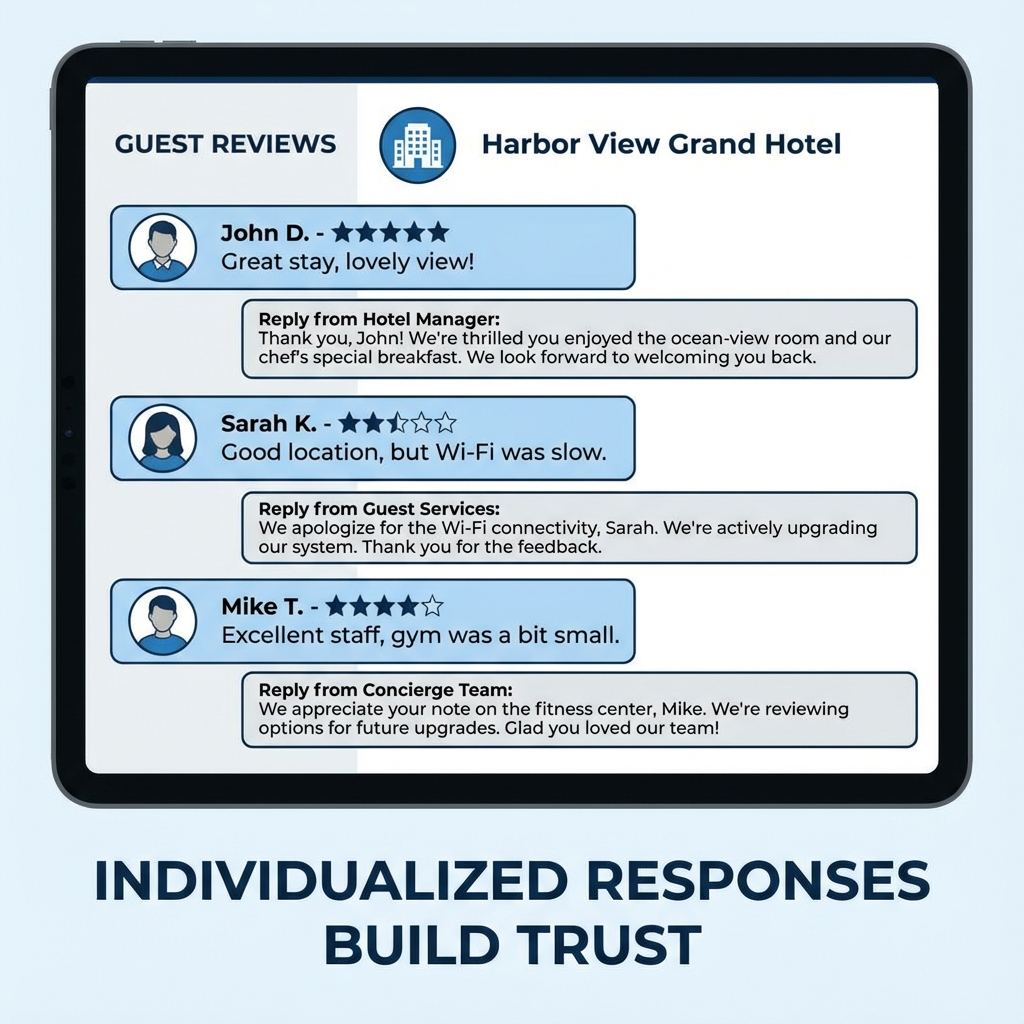
What “individually” actually means
Individual doesn’t mean long. It means your reply includes at least one detail that proves you read the review and you’re responding as a real team:
- one specific highlight (“breakfast buffet”, “late check-in”, “family room”)
- one concrete fix (for negative feedback)
- one location/property cue (for groups)
- the right tone for the review (warm for praise, calm and accountable for complaints)
Two to five sentences is usually enough.
Why individualized responses drive bookings
1) They increase credibility
Prospective guests expect reviews. What they don’t expect is a hotel that consistently replies with specificity and professionalism. That stands out, especially when competitors use generic templates.
2) They de-risk the purchase
Booking a hotel is emotional and expensive. A specific response shows there are real people behind the property and that issues get handled.
3) They protect you from “spammy” patterns
Platforms and guests both notice repetitive replies. Even when you’re responding with good intent, identical language can look automated and damage trust.
The biggest mistake: templates without personalization
Templates are useful—but only as a starting structure.
If every response begins with the same sentence and ends with the same sign-off, readers stop believing the replies. The fix is simple: keep the structure, change the proof.
Use a “template + proof” approach:
- Template: the core structure (thank → specific → next step)
- Proof: one unique detail from the review or stay context
A simple system to personalize every reply
Here’s the fastest workflow we’ve seen work for hotel teams.
Step 1: Choose a single response framework
Use one consistent structure so anyone on the team can respond quickly:
THANK → SPECIFIC → COMMIT → INVITE
- THANK: thank them for the review and the stay
- SPECIFIC: mention one detail they shared
- COMMIT: reinforce what you’ll keep doing (positive) or what you’ll improve (negative)
- INVITE: invite them back (positive) or take it offline (negative)
Step 2: Define “personalization tokens”
Create a short list of details your team should try to include:
- department (front desk, housekeeping, F&B)
- amenity (spa, gym, parking)
- scenario (early check-in, noise, cleanliness, billing)
- location (city, neighborhood, landmark)
If the review doesn’t include details, pick a safe, non-claim detail (like thanking them for “staying with us” rather than praising a specific amenity).
Step 3: Scale drafting without scaling labor
For busy properties, the bottleneck is writing—not deciding what to do.
That’s where an AI-assisted workflow helps: generate a draft in your brand voice, then add one “proof” detail before publishing. ReviewAgent is built for this pattern (draft fast, personalize, approve when needed).
[!TIP] If you want to respond faster on Google specifically, start here: How to Respond to Every Google Review in Seconds
Quick examples of “individual” without being long
- 5-star review: thank them + name one highlight + invite back
- 3-star review: validate + name one issue + state one improvement
- 1-star review: apologize + accountability + offline follow-up path
If you need ready-to-use structures for these scenarios, use our Hotel Review Response Templates.
What to do when a review is unfair or wrong
Stay calm and write for the future reader:
- acknowledge their experience (“I’m sorry it felt that way”)
- share a neutral fact if necessary (no arguing)
- invite a direct conversation to resolve it
For more detailed guidance, see: How to Respond to Negative Hotel Reviews
Conclusion
Responding to reviews individually is one of the highest-leverage things a hotel can do online. It’s not about writing more—it’s about writing specific.
If you standardize the structure, keep one personalization detail, and use tools to draft faster, you can scale individualized responses without adding hours of work.
Share this Article
Link copied!