21 Hotel Reputation Management Strategies That Drive Bookings
A practical checklist of reputation management strategies for hotels—monitoring, response workflows, review generation, operational fixes, and multi-location consistency.
Hotel reputation management isn’t about “looking good online”. It’s about winning the booking when guests compare similar options.
Here are 21 practical strategies you can implement with a small team—especially if you centralize reviews and responses across platforms.
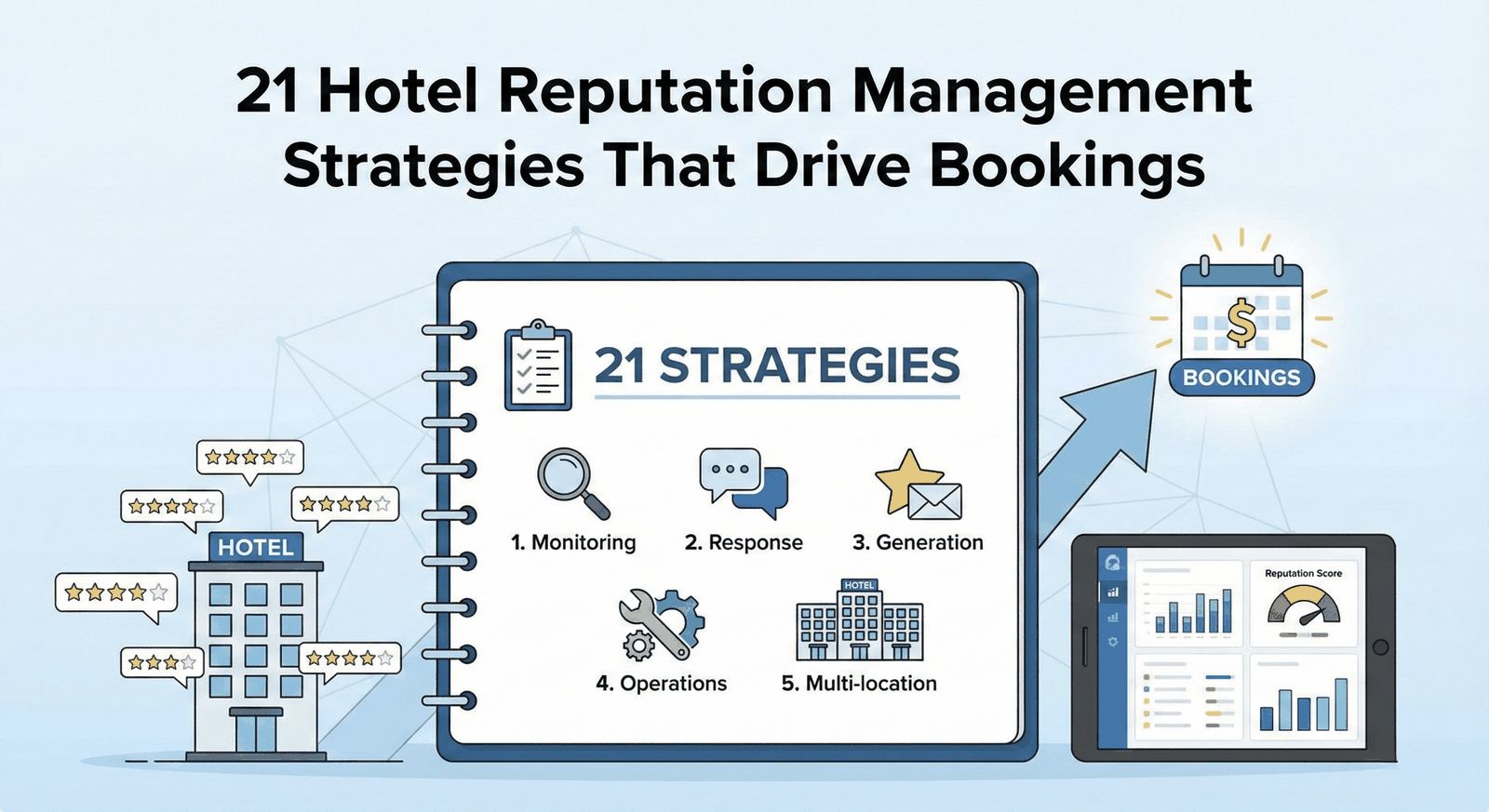
Monitoring and coverage
1) Centralize reviews in one queue
If your team has to log into multiple platforms, coverage will always be inconsistent. A unified inbox is the foundation.
2) Set response SLAs
Decide: e.g., respond to 1–2 star reviews within 24 hours, all others within 48–72 hours.
3) Track response rate by platform
Many hotels reply on Google but ignore OTAs (or the reverse). Guests notice.
4) Assign clear ownership
One person accountable per property (and a manager for escalations) beats “everyone can respond”.
Response quality (the part guests read)
5) Use a consistent response framework
Fast and human:
THANK → SPECIFIC → COMMIT → INVITE
Start here: How to Respond to Every Google Review in Seconds
6) Personalize with one “proof” detail
One real detail is the difference between “we care” and “template spam”.
Read: The Importance of Responding to Reviews Individually
7) Create escalation rules for negatives
Define what needs manager review: 1–2 stars, safety incidents, legal allegations, discrimination claims.
8) Take complex issues offline
Public replies should be short. Offer a direct contact channel for resolution.
9) Never share personal data
Avoid reservation details, names beyond what the reviewer used, or anything that could identify a stay.
10) Build a template library (but don’t copy/paste blindly)
Use templates as structure + a unique detail each time.
Use: 15+ Essential Hotel Review Response Templates
Review generation (ethical, consistent)
11) Ask at high-satisfaction moments
Train staff to recognize the moment and ask once, politely.
12) Use post-stay email with one CTA
Short email, one link/QR, no incentives.
13) Make it easy at the front desk
QR codes work best when paired with a simple script.
14) Don’t “review gate”
Avoid only asking happy guests. It’s risky and usually backfires.
Operations: fix what keeps showing up
15) Turn themes into tickets
If “noise” shows up weekly, it’s not a comms problem—it’s an ops problem.
16) Review themes monthly (per property)
Top 3 positives to reinforce, top 3 negatives to fix, owners + deadlines.
17) Close the loop publicly
When you improve something, mention it in replies (“We’ve adjusted…”) without over-promising.
18) Train teams on the “review mindset”
Reviews are product feedback. Treat them like a recurring ops meeting agenda.
Multi-location and brand consistency
19) Standardize tone by brand
Define tone presets (professional, friendly, luxury) so replies feel consistent across properties.
20) Use approvals instead of bottlenecks
Draft fast, approve sensitive cases. Don’t force every review through the GM.
21) Report what matters
Response time, response rate, theme trends, and star trends are enough to drive action.
If you want to quantify impact, use the ROI calculator.
Conclusion
The best hotel reputation strategy is the one you can run every week. Centralize, respond fast with real details, and fix recurring issues.
If you want the full foundation, read: Hotel Reputation Management: The Ultimate Guide for 2025
Share this Article
Link copied!