Personalized AI-Generated Review Replies: How to Keep Responses Human (Hotels Guide)
A practical system to personalize AI-generated review replies without making things up—templates, guardrails, and a workflow built for busy hotels and multi-location teams.
When you’re responding to reviews every day, there’s a real tension:
- Personalization builds trust and drives bookings.
- Speed is what keeps your response rate high.
That’s why “AI-generated review replies” are becoming popular. The problem is that many AI replies read like generic templates—or worse, they accidentally invent details.
This guide shows how hotels can use AI to draft faster without losing the human touch.
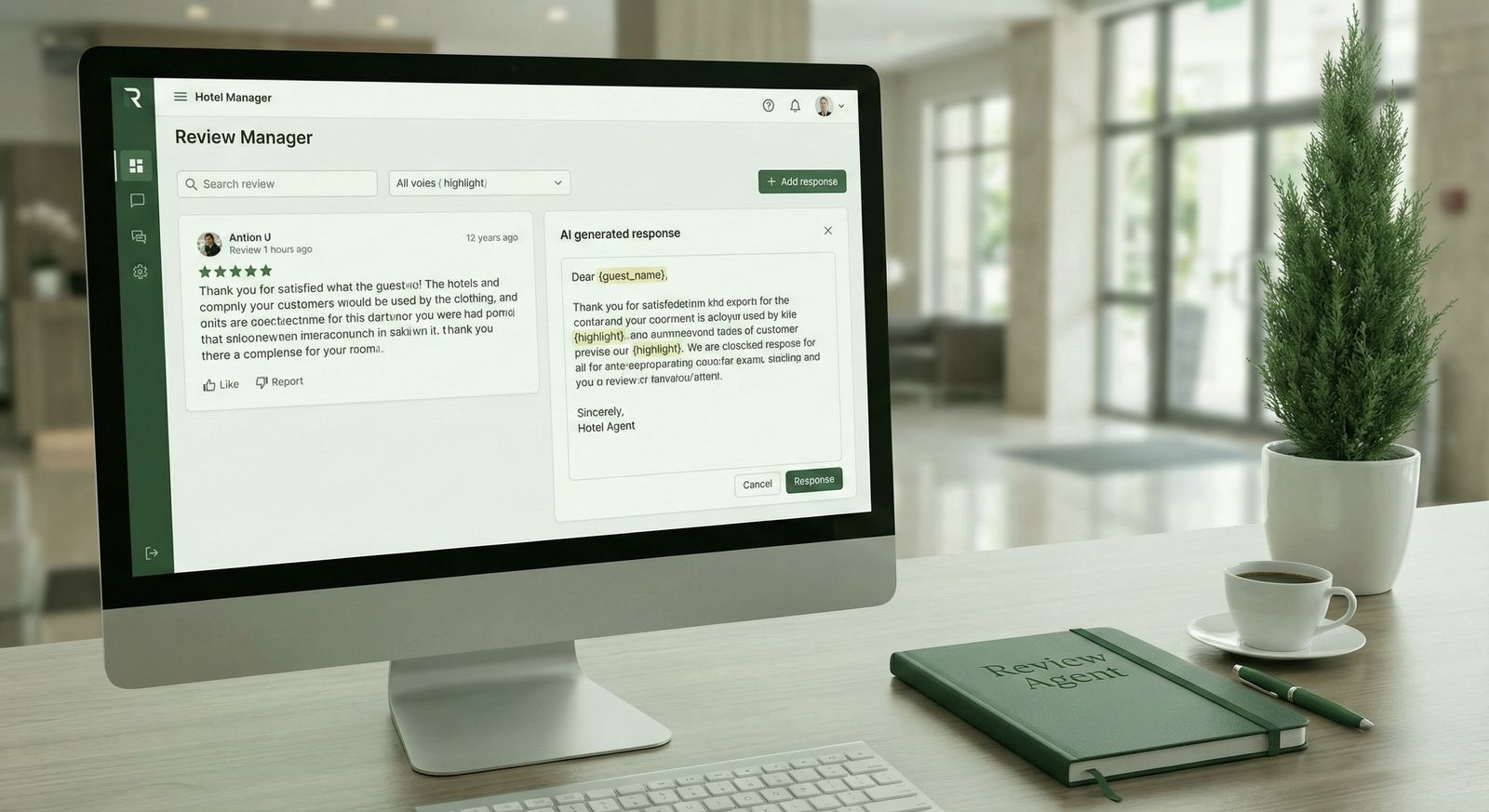
The “no contradiction” rule: AI + personalization can coexist
There’s no contradiction between personalization and AI-generated review replies if you treat AI as:
- a drafting assistant (structure + tone), and
- a consistency engine (brand voice + guardrails),
while humans stay responsible for:
- accuracy
- empathy
- the final “proof” detail that makes the response unmistakably real
What personalization really means (and what it doesn’t)
Good personalization in a review reply usually means:
- referencing something the guest mentioned (“breakfast variety”, “late check-in”, “quiet room”)
- acknowledging the emotion (“frustrating”, “so glad”, “disappointing”)
- naming a concrete next step (“we adjusted staffing at peak check-in times”)
Bad personalization is:
- guessing details that weren’t shared (“we’re sorry your suite had…”)
- mentioning private information (reservation details, names, booking IDs)
- making promises you can’t guarantee (“this will never happen again”)
[!TIP] Personalization is not “adding more words”. It’s adding one true detail and one true next step.
What you can safely personalize from (hotel-friendly sources)
Use these inputs to keep replies specific without crossing privacy lines:
- The review text itself (the safest source)
- Public hotel facts (amenities, opening hours, location, brand name)
- Seasonal context (high season, holidays) only if it stays general
- Your brand voice rules (tone, length, do/don’t phrases, signature)
- Your internal operations playbook (how you handle noise complaints, housekeeping follow-ups, etc.)
Avoid using anything that could expose personal data or create “creepy” replies.
The 3-layer system for personalized AI review replies
If you want replies that feel human and scale across a team, use this structure:
Layer 1: A template that never changes
Use a reliable framework:
THANK → SPECIFIC → COMMIT → INVITE
- THANK: thank them for the stay/feedback
- SPECIFIC: echo one detail they shared (or ask for one if none is given)
- COMMIT: confirm a concrete action or principle
- INVITE: invite them back or take it offline
Layer 2: Safe “slots” you fill in
Examples of safe slots:
{highlight}(breakfast, staff friendliness, location, room comfort){fix}(staffing, maintenance check, training refresh, follow-up process){contact}(email/phone + role, like “Guest Relations Manager”)
Layer 3: The “human proof” detail
The fastest way to make AI-generated review replies feel real is adding one proof detail:
- the exact phrase the guest used (“quiet room”)
- a specific area of the property (spa, lobby bar, breakfast buffet)
- a real operational step you truly do (maintenance check, team brief)
One proof detail is usually enough.
A 60-second workflow (built for hotel teams)
Here’s a workflow that works especially well for multi-location operations:
Step 1: Triage (10 seconds)
Decide what needs a manager’s eyes:
- 1–2 stars: manager approval required
- 3 stars: empathy + one improvement
- 4–5 stars: concise thanks + one highlight + invite back
Step 2: Draft in your brand voice (20 seconds)
With a tool like ReviewAgent, your team can generate a draft that follows your tone guidelines and a proven structure—then edit before publishing.
Step 3: Add one proof detail (20 seconds)
Add one true detail:
- “We’re glad you enjoyed the breakfast buffet.”
- “We’re sorry the noise affected your sleep.”
- “Thanks for highlighting how helpful the front desk team was.”
Step 4: Accuracy check (10 seconds)
Before you post:
- Did we invent anything?
- Did we promise something unrealistic?
- Did we include personal data?
If the answer is yes, rewrite that line.
Examples: personalized AI-generated review replies (good vs. risky)
Below are hotel-friendly examples you can adapt. Keep the structure, swap the details.
5-star review mentioning breakfast
Reply
Thanks for your wonderful feedback—and for mentioning the breakfast buffet. We’re glad the variety helped you start the day right. We’ll share your note with the team, and we hope to welcome you back on your next trip.
4-star review with minimal detail
Reply
Thank you for staying with us and for the 4-star rating. If there’s one thing that would have made your visit even better, we’d love to hear it—your feedback helps us improve. We hope to welcome you back soon.
3-star review mentioning slow check-in
Reply
Thank you for the feedback. We’re sorry the check-in felt slow—that’s a frustrating way to start a stay. We’re reviewing peak-time staffing so arrivals move more smoothly. If you’re open to sharing the date/time of arrival, our team can look into it more closely.
1-star review mentioning cleanliness
Reply
We’re sorry to hear this, and we appreciate you taking the time to leave feedback. Cleanliness is a basic expectation and we clearly fell short. We’re following up internally with housekeeping and a room inspection process review. If you’re willing, please contact our team so we can understand what happened and make it right.
Suspected fake or unclear review
Reply
Thank you for the feedback. We’d like to understand what happened, but we don’t have enough detail to investigate. If you visited us recently, please contact our team with the date of stay so we can look into it and respond appropriately.
[!NOTE] Avoid accusing someone publicly of leaving a fake review. Keep the tone calm and invite details.
Personalization checklist (print this for your team)
- Include one true detail from the review (or ask for it).
- Use your brand voice (tone, length, sign-off).
- Keep it specific but non-private (no reservation info).
- For negatives, include a real next step (what you’ll review/change).
- For multi-location, include the property name only if you’re sure it’s correct.
FAQ
Do AI-generated review replies hurt SEO or trust?
Not if they’re accurate and specific. What hurts trust is generic copy/paste replies that look automated. A short reply with one real detail typically performs better than a long generic one.
Should we respond to every review?
For hotels, consistency matters—especially for negative and mixed reviews. If you need a fast workflow, start here: How to Respond to Every Google Review in Seconds
How do we keep replies consistent across properties?
Use a shared brand voice guide, triage rules, and an approval step for sensitive reviews. If you manage multiple locations, also read: Best Reputation Management Software for Hotels (2025): Buyer’s Checklist
Read next
Share this Article
Link copied!