A First-Party Guest Feedback Engine to Reduce OTA Dependency
OTAs own distribution—but you can own guest trust. Learn how to use review data as first-party feedback to improve operations, boost local visibility, and drive more direct bookings.
OTAs are part of hospitality. But OTA dependency becomes a problem when your property’s story is being told everywhere—except on your own channels.
The good news: you already have “first-party data”. It’s not a CDP export. It’s what guests are telling you publicly every day in reviews.
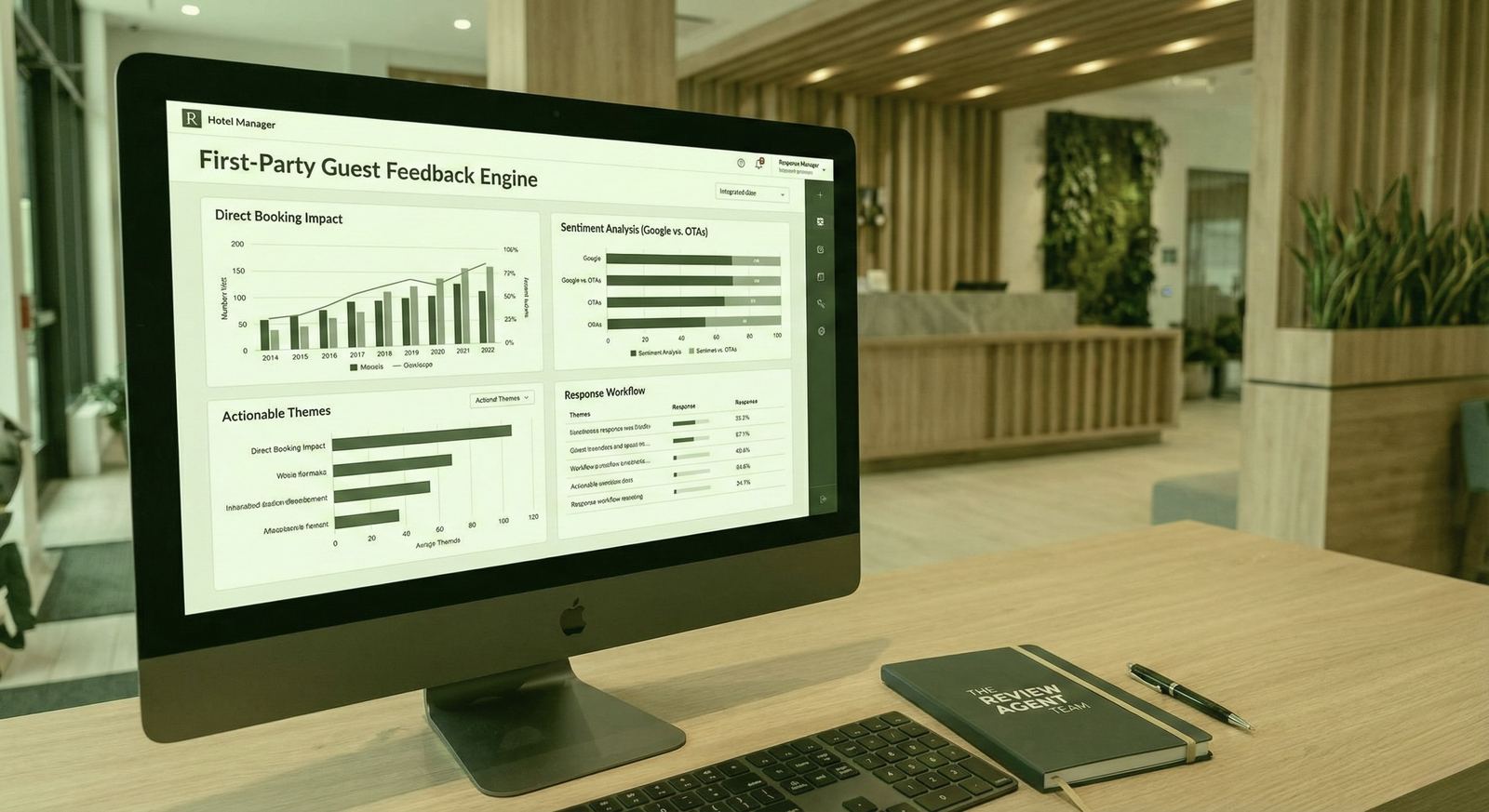
This guide shows how hotels can build a first-party guest feedback engine using review data to improve trust, local visibility, and direct bookings.
First: what we mean by “first-party” (and what we don’t)
This is not a CDP. We’re not claiming you’ll unify identities across PMS/CRM, stitch sessions, or build full customer profiles.
This is simpler—and usually more useful:
- your guests’ own words across Google and OTAs
- the themes that repeat
- the operational fixes that actually move your rating and conversion
- the response workflow that shows future guests you care
Why review data reduces OTA dependency (indirectly)
You don’t “beat OTAs” with one tactic. You reduce dependency by making direct booking feel safer and more obvious:
- Trust: consistent, specific replies make your hotel feel well-run.
- Local visibility: strong Google Business Profile activity drives more website clicks.
- Conversion: guests reading responses are more likely to choose you over a similar option.
The engine: a practical workflow hotels can run weekly
Step 1: Centralize reviews (Google + OTAs) into one workflow
If your team has to log into multiple platforms, coverage will always be uneven.
With Review Agent, you can pull reviews from Google, Booking.com, TripAdvisor, Expedia, HolidayCheck, and more into one place so nothing gets missed.
Step 2: Turn unstructured text into themes you can act on
Reviews aren’t just “rating”. They’re a backlog of issues and advantages:
- what guests love (location, staff, breakfast)
- what hurts conversion (noise, Wi‑Fi, cleanliness, check‑in)
The goal is a short, repeatable rhythm:
- top 3 positive themes to reinforce
- top 3 negative themes to fix
- owners + deadlines for fixes
Step 3: Respond fast without sounding robotic
The fastest way to lose trust is obvious copy/paste.
Use a structure + one real detail:
THANK → SPECIFIC → COMMIT → INVITE
Start here: - How to Respond to Every Google Review in Seconds - The Importance of Responding to Reviews Individually
Step 4: Strengthen your Google Business Profile (GBP)
Direct bookings often start on Google. GBP isn’t just “profile hygiene”—it’s a channel.
Use this guide: - Google My Business Optimization for Hotels (2025)
Step 5: Close the loop so fixes become marketing
When you actually improve something, mention it in replies (without over-promising):
“We’ve adjusted our check‑in staffing during peak hours—thank you for calling it out.”
That’s how operations becomes credibility.
What to measure (so it’s not just a “content project”)
Start with a few metrics you can control:
- response rate (by platform)
- response time (especially for 1–2 star reviews)
- recurring negative themes (and whether they drop after fixes)
- clicks from GBP to your website (use UTMs)
If you want a quick projection, use the ROI calculator.
Conclusion
You don’t need a CDP to reduce OTA dependency. You need a system that turns guest feedback into better operations and better public proof.
Next: Guest Feedback Scorecard for Hotels (Metrics That Matter)
Share this Article
Link copied!