Hotel Loyalty vs OTAs: Why Direct Bookings Matter More in the Age of AI Agents
Hotel giants are doubling down on loyalty programs to reduce OTA commissions and prepare for AI travel agents. Here’s what it means for hotels—and how to win more direct bookings with reputation signals.
For years, big hotel groups have openly disliked how much online travel agencies (OTAs) charge for bookings. Now the pressure is rising again—because distribution is about to change.
Large brands are investing heavily in loyalty programs and direct booking perks to:
- reduce OTA commission costs (often quoted in the 15–25% range), and
- get ready for a future where AI travel “agents” might choose hotels on a guest’s behalf.
If you run a hotel (or a group of properties), the takeaway is simple: the competition isn’t only “hotel vs hotel” anymore—it’s also direct relationship vs intermediary.
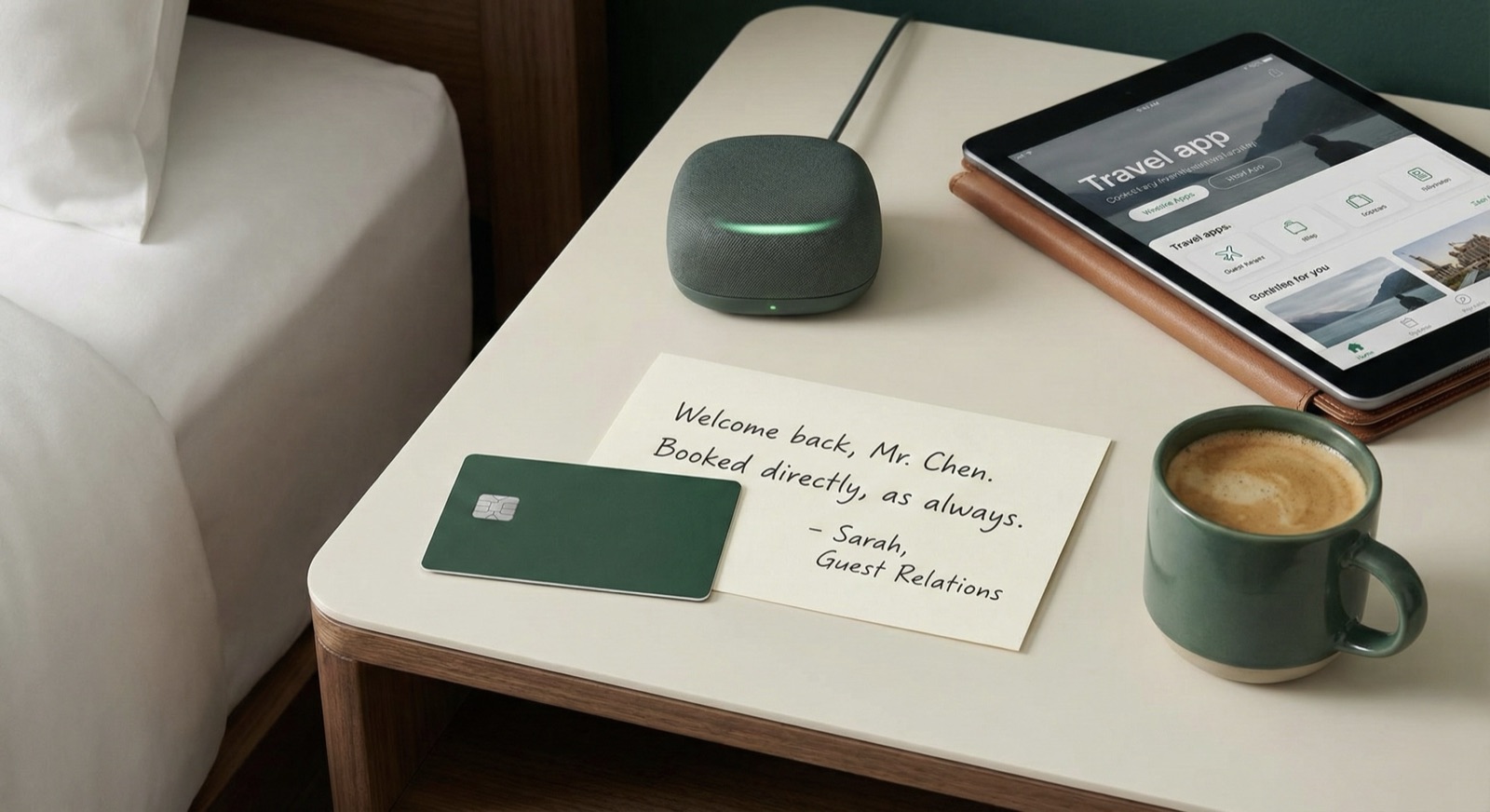
Why hotel groups are pushing direct bookings harder
Hotels work with OTAs for a reason: they can deliver incremental demand and fill gaps. But there’s a cost.
When an OTA takes a percentage of every booking, the hotel gives up margin and (often) part of the guest relationship. That’s why major groups have been strengthening programs that:
- incentivize guests to sign up and book direct,
- make “member rates” and perks feel meaningful,
- expand how points and benefits can be earned or used.
One major program reportedly reached ~260 million members by late 2025, with double-digit year-on-year growth—an indicator of how aggressively direct-relationship strategies are scaling.
The “perk arms race”: status, partnerships, and experiences
Direct booking is not only about discounts. It’s about making the direct channel feel better:
- easier paths to elite status
- partnerships that extend point redemptions beyond the brand’s own portfolio
- special experiences that are hard to replicate through an OTA
These are “sticky” benefits. They help keep guests inside an ecosystem instead of shopping purely on price.
A quick snapshot of what big brands are signaling
Recent public commentary from major players points in the same direction:
- Loyalty scale keeps growing: Marriott has said its Bonvoy program is approaching 260M members, up meaningfully year-over-year.
- Perks and partnerships are getting broader: Hilton has talked about making elite status easier and expanding partnerships where points can be used outside its own hotels (including cruise-related partnerships).
- Groups are thinking about AI distribution costs: leaders have suggested bookings coming through future AI channels could be cheaper than today’s OTA model.
- OTAs are watching closely: Booking Holdings has acknowledged that hotel loyalty programs compete directly with OTAs for the guest relationship, while Expedia argues there’s “room for all” and highlights the value OTAs bring—especially for smaller operators.
You don’t have to agree with every claim to see the underlying strategy: own the relationship, reduce reliance, and stay visible wherever the guest chooses to book.
AI travel agents: cheaper distribution—or a new kind of gatekeeper?
The next wave isn’t just OTAs. It’s agent-led travel planning.
In conversational, AI-driven booking flows, guests may stop browsing ten tabs and instead ask an assistant to “book the best option.” That can be good news for hotels if it lowers distribution costs. But it can also be risky:
- AI agents can make guests less brand-aware (commoditizing the choice).
- A hotel can become “one option in a list,” ranked by signals the agent trusts.
In other words: the channel might get cheaper, but the competition for “top recommendation” gets fiercer.
What this means for hotels that aren’t global chains
Independent hotels and smaller groups may not have a massive loyalty program. But you still have powerful levers to compete—because AI agents and direct-booking guests both rely on trust signals.
Direct bookings also matter because they help hotels capture more first-party guest data and tailor the experience over time. Even without a “mega program,” you can still build repeat business by turning feedback into action.
The biggest trust signals are not slogans. They’re proof:
- your review volume and recency
- your average rating
- how you respond (speed, tone, professionalism)
- recurring themes in feedback (cleanliness, noise, breakfast, service)
Those signals influence both humans and algorithms.
The overlooked direct-booking lever: review responses
If a guest is deciding between two similar hotels, your review section is often the tiebreaker—especially on Google and OTAs.
Two hotels can have the same star rating, but one will win more direct bookings because it looks:
- attentive (fast responses),
- caring (specific replies),
- credible (calm service recovery on negatives).
If you want a fast workflow for Google specifically, start here: How to Respond to Every Google Review in Seconds
A practical playbook to win more direct bookings (without a mega loyalty program)
Here are steps hotels can execute today:
- Respond consistently across platforms. Don’t let any channel become a “silent location.”
- Use a fixed structure + one proof detail so replies stay personal (not copy/paste).
- Triage negatives with approvals so sensitive replies stay controlled.
- Turn themes into action (fix what guests repeat: noise, Wi‑Fi, check-in, cleanliness).
- Show social proof on your own site (curated snippets + source link) to support direct conversion.
- Make direct perks simple and believable (late checkout when available, flexible policies, small upgrades)—and communicate them clearly.
If you want help with #1–#4 at scale, Review Agent is built for that workflow: it drafts on-brand replies quickly and helps teams stay consistent across locations and platforms.
How Review Agent fits into the “loyalty vs intermediaries” strategy
Review Agent doesn’t replace your booking engine or loyalty program. It supports the part that directly affects trust at the moment of decision:
- consolidating review response work into a repeatable process,
- keeping tone consistent across staff and properties,
- helping you respond faster without sounding robotic,
- surfacing themes so operational fixes happen sooner.
That’s how review management becomes a direct booking asset—not just a marketing task.
Read next
Share this Article
Link copied!